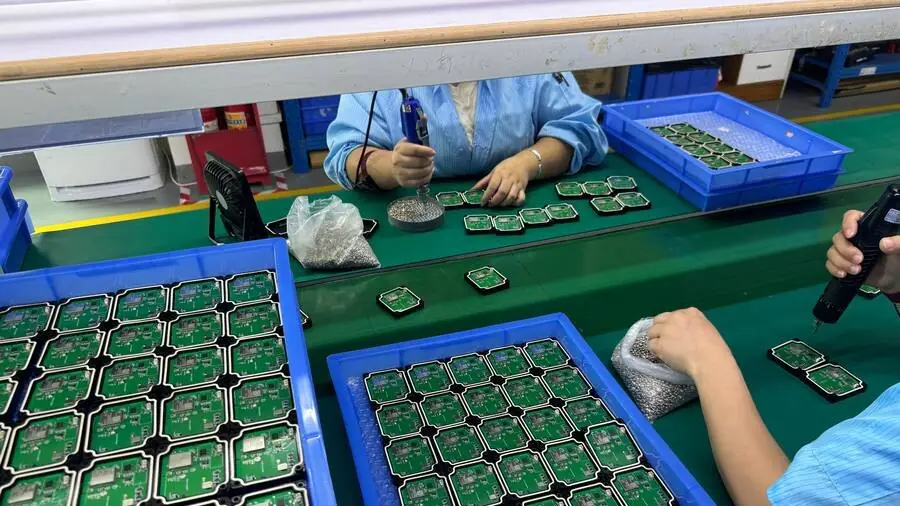
A note on the photographs in this article. They were taken by us at a partner facility in Shenzhen. LEXUNYU does not manufacture anything — we are a sourcing and validation partner, and these are suppliers we assess on behalf of buyers, not plants we own. Faces have been obscured; nothing else has been retouched.
Why the sample tells you less than the line
A useful factory review asks whether the production process can reproduce the approved sample. Compare the agreed component configuration, firmware and test records with the proposed batch, and record how substitutions or version changes will be approved.
A production line answers a different question from a sample. The sample tells you what the product can be. The line tells you what it will be at volume, on a Tuesday, when the order behind yours is late.
1. The assembly bench: how much is human
The first thing worth counting is how many operations are done by hand. In this category almost all of them are — these units are small, low-volume by electronics standards, and the housings vary too much for full automation to be worth it.
That is not a problem in itself. What matters is whether the manual steps are constrained: torque-limited screwdrivers rather than free-spinning ones, ESD trays rather than loose piles, one operation per station rather than one person assembling a whole unit. Those things decide whether unit 300 is torqued the same as unit 1.

What we look for at this bench, in order:
- Are the boards in anti-static trays, or in bulk? Trays cost money and slow the line down. A supplier who pays that cost is telling you something.
- Are the screwdrivers torque-limited? Over-torqued screws crack housings; under-torqued ones let water in six months later, in the field, on your fleet.
- Is there a rework pile, and how big is it? Every line has one. A supplier who hides it is worse than one who shows you a big one.
- Does one person do one step? Whole-unit assembly by one operator looks efficient and produces the widest variation.
2. The test station: one important place to check for drift
A factory review should examine the test station as one important place to check whether a batch still matches the approved sample. Assembly, firmware and RF checks need their own records; ask for the flashed version, relevant test evidence and a per-serial result record.

The questions worth asking here are unglamorous and they are the ones that decide your RMA rate:
| Ask | What a weak answer sounds like |
|---|---|
| Is every unit tested, or a sample? | "We test enough." Get a percentage, and get it in the order terms. |
| What does the test actually check? | "It powers on." Powering on is not a test. Ask which of GNSS fix, cellular attach, SIM, accelerometer, inputs and outputs are exercised. |
| Is the result recorded per unit? | "The operator watches the screen." Without a logged record per serial number, a field failure cannot be traced back to a batch. |
| Which firmware version is flashed here? | Silence, or a version that differs from your sample. This single question explains a large share of "the batch behaves differently" complaints. |
| Who changes the firmware, and does the buyer get told? | "The engineer updates it when there is a fix." Fine — as long as it is written into the order that you are notified. |
If you only ask one thing on a factory visit, ask which firmware version is being flashed at the test station, and compare it to the version in the sample you approved. It costs nothing and it catches the most expensive class of surprise.
3. Welding and sealing: where the IP rating is actually decided
An IP rating on a datasheet is a laboratory result for a correctly assembled unit. Whether your units are correctly assembled is decided at the sealing stage — ultrasonic welding, gasket seating, or glue, depending on the housing.

What we want to see: a fixed welder setting rather than an operator adjusting it by feel, and some form of check after sealing rather than after complaint. For anything going onto a trailer, a plant machine or an outdoor asset, this stage matters more than any specification on the front page of the datasheet — see GPS trackers for equipment for what those conditions do to hardware in the field.
4. Line size: what it says about your order
Buyers tend to read a long line as reassurance. It is worth reading more carefully than that. A large line means the supplier has other customers, which is good for their survival and bad for your priority. A small line means you matter more and they may not absorb a surge.

The useful question is not "how big is the line" but "where does my order sit in the queue, and what happens to it when a bigger one arrives". Ask what else is running this month. Ask what happened to the last order that slipped, and why.
5. Packing: the stage nobody inspects and everybody regrets
Packing is treated as an afterthought until a pallet arrives with mixed labels, or customs holds a shipment because the carton markings do not match the invoice.

Worth confirming before the first shipment, not after: what is printed on the carton label, whether serial ranges are recorded per carton, how many units per carton and per pallet, and whether accessory kits are packed with the unit or shipped separately. Every one of these has caused a real delay for someone, and all of them are free to fix in advance.
What a factory visit cannot tell you
It is worth being honest about the limits, because plenty of sourcing content is not.
- It cannot tell you the components are the same next quarter. A GNSS module or a cellular module can be substituted between batches for supply reasons. Only a written change-notification clause protects you, not a visit.
- It cannot tell you the firmware will not move. See above. Ask, write it down, and pin the version.
- It cannot verify certification. Certificates are documents, and documents are checked against the specific model and variant — not against a family name that looks similar. A tidy factory proves nothing about paperwork.
- It cannot tell you how they behave when something goes wrong. That only shows up in the first RMA, which is why a small validation batch is worth more than a good visit.
If you cannot fly to Shenzhen
Most buyers cannot, and do not need to. The substitutes, in rough order of value:
- Order a representative validation batch. Cover the asset classes, power conditions, configurations and checks that matter to the project, then compare the results with the agreed acceptance criteria.
- Ask for the per-unit test record for those units, by serial number. The willingness to provide it is itself the answer.
- Ask for a short video of the test station, not a promotional video. Two minutes of the actual fixture running is worth more than a brochure.
- Pin the firmware version in writing before the first order, with a notification clause for changes.
- Send someone who is already there. That is a large part of what we do — see sourcing GPS trackers from China for how the comparison and validation stage actually runs, and sourcing at fleet scale for what changes when the order is for a whole fleet rather than a pilot.
A good factory visit does not make you confident. It makes you specific about what to write into the order.
Frequently asked questions
Is LEXUNYU a factory?
No. LEXUNYU is a Shenzhen-based sourcing and validation partner. We do not manufacture and we do not hold stock. The facilities photographed in this article are partner suppliers we assess on behalf of buyers.
Can I visit the factory myself?
Visits are arranged with the manufacturer concerned and depend on their agreement and the stage of the project. For most buyers a small validation batch answers more questions than a visit, at lower cost.
What is the single most useful question to ask on a factory visit?
Which firmware version is being flashed at the test station, and whether it matches the sample you approved. It is free to ask and can expose a costly category of batch surprise.
How should a validation batch be planned?
There is no universal count. Define a representative sample plan around the asset classes, power conditions, configurations and checks that matter to the project, then agree the acceptance criteria before ordering.
Do you provide the test records?
Where the manufacturer records results per unit, yes — those records belong to your project, not to us. Where a manufacturer cannot produce them, that is information worth having before you order.
How do I know the certification is real?
Certificates are issued by the manufacturer, not by LEXUNYU, and are checked against the exact model and variant before an order. A certificate covering a similar-looking model in the same family does not automatically cover yours.
What is the minimum order quantity?
Customisation — labels, packaging, appearance, harnesses, firmware or protocol work — typically starts from 100 units. Samples and small pilot quantities are handled separately.
What warranty applies?
A 12-month limited warranty from the shipment date shown on the commercial invoice. DOA must be reported within 30 days of delivery; approved replacements ship at our cost.