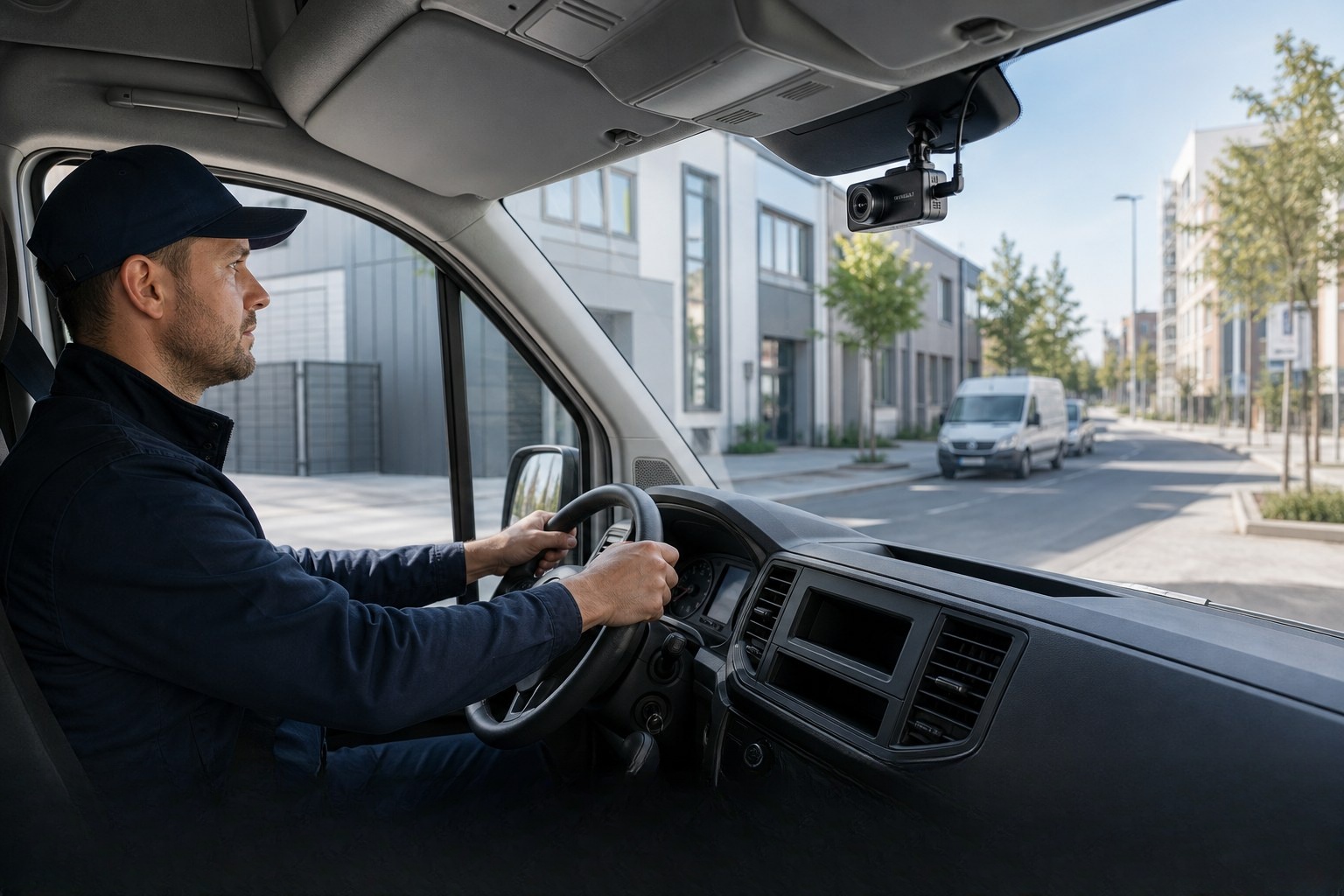
Two shifts are hitting European fleets at the same time. From 1 July 2026 the EU smart tachograph requirement reaches light commercial vans, and across the continent mobile networks are retiring the old 2G and 3G bands that many older tracking devices still depend on. If you buy or specify GPS hardware for vans and light commercial vehicles in Europe, both changes change what "compliant" actually means.
This is not a regulatory alarm post. It is a practical note on what to specify so the hardware you source stays connected and road-ready, instead of becoming a silent box in six months.
What changed with the EU smart tachograph rule
The EU smart tachograph rule, already mandatory for heavy trucks and buses, was extended on 1 July 2026 to cover vans and light commercial vehicles from 2.5 to 3.5 tonnes engaged in international transport. The smart tachograph adds GNSS positioning and motion sensors on top of the classic driver-card recording, so enforcement can see position and movement without pulling the vehicle over.
For hardware buyers, the practical point is readiness: vehicles in scope increasingly need a clean way to capture and report position and movement data. That does not mean every tracker must be a certified tachograph — regulatory approval stays with the authorised process and your operation. But it does raise the bar on position accuracy, sensor quality and data continuity for any device fitted to those vehicles.
The 2G shutdown is quietly bricking older trackers
Separately, European operators are switching off 2G and 3G. In several countries 3G is already gone and 2G retirements are scheduled through the late 2020s. A GPS tracker that only speaks 2G loses its link to the server the moment the local 2G signal disappears — and it does so silently, often far from where anyone is watching.
For fleets that deployed cheap 2G units a few years ago, this is the real risk: the hardware still looks fine, the battery is fine, but nobody can see the vehicle. Retrofitting a whole fleet after the network goes dark is expensive and disruptive. Specifying the right network today avoids that scramble.
What to specify when sourcing GPS tracking hardware for Europe
When you compare devices or talk to a factory, these are the points that matter for the European market in 2026:
- 4G LTE connectivity as the baseline, with Cat M1 / NB-IoT where the vehicle operates in rural or covered areas with weaker coverage.
- Multi-network fallback so the device is not tied to a single operator that may retire a band first.
- GNSS plus optional inertial data to keep a continuous position through tunnels, covered yards and short satellite gaps.
- CAN / J1939 support where the vehicle data (engine hours, ignition, fault codes) needs to feed the same record.
- Remote configuration and OTA updates, so a settings or server change does not mean recalling the unit.
- CE / FCC and RoHS documentation confirmed per product before order — see our FAQ on certifications.
None of this requires a flagship module. It requires choosing hardware that was designed for the networks and workflows Europe actually runs in 2026, not 2019.
A sourcing partner helps you avoid the retrofit trap
The hard part is not finding a tracker — it is confirming the one you choose will still work next year, on real vehicles, in the markets you sell into. As a Shenzhen GPS hardware sourcing partner, we compare verified factories, coordinate samples and validate devices on real equipment before a larger commitment. You get the network and compliance check as part of selection, not as a surprise six months later.
Our process is built around that validation step: define the vehicle and market, sample the candidate devices, test the communication and data fields against your platform, then scale. It is the opposite of buying a pallet of the cheapest 2G unit and hoping the network holds.
Key takeaway for 2026 sourcing
- Specify 4G LTE (Cat M1 / NB-IoT where relevant), not 2G, for any new European deployment.
- Treat the 1 July 2026 tachograph expansion as a prompt to raise the bar on position and sensor quality for vans in scope.
- Validate the device on real vehicles and confirm CE / FCC and network bands before you commit.
If you are planning a European rollout and want a shortlist of devices that fit these requirements, tell us the vehicle type and target countries. We will map it to verified hardware and a realistic validation plan.